


By VeVe Staff · February 4, 2026
Spoiler Warning: Light spoilers ahead for some Vampirella storylines.
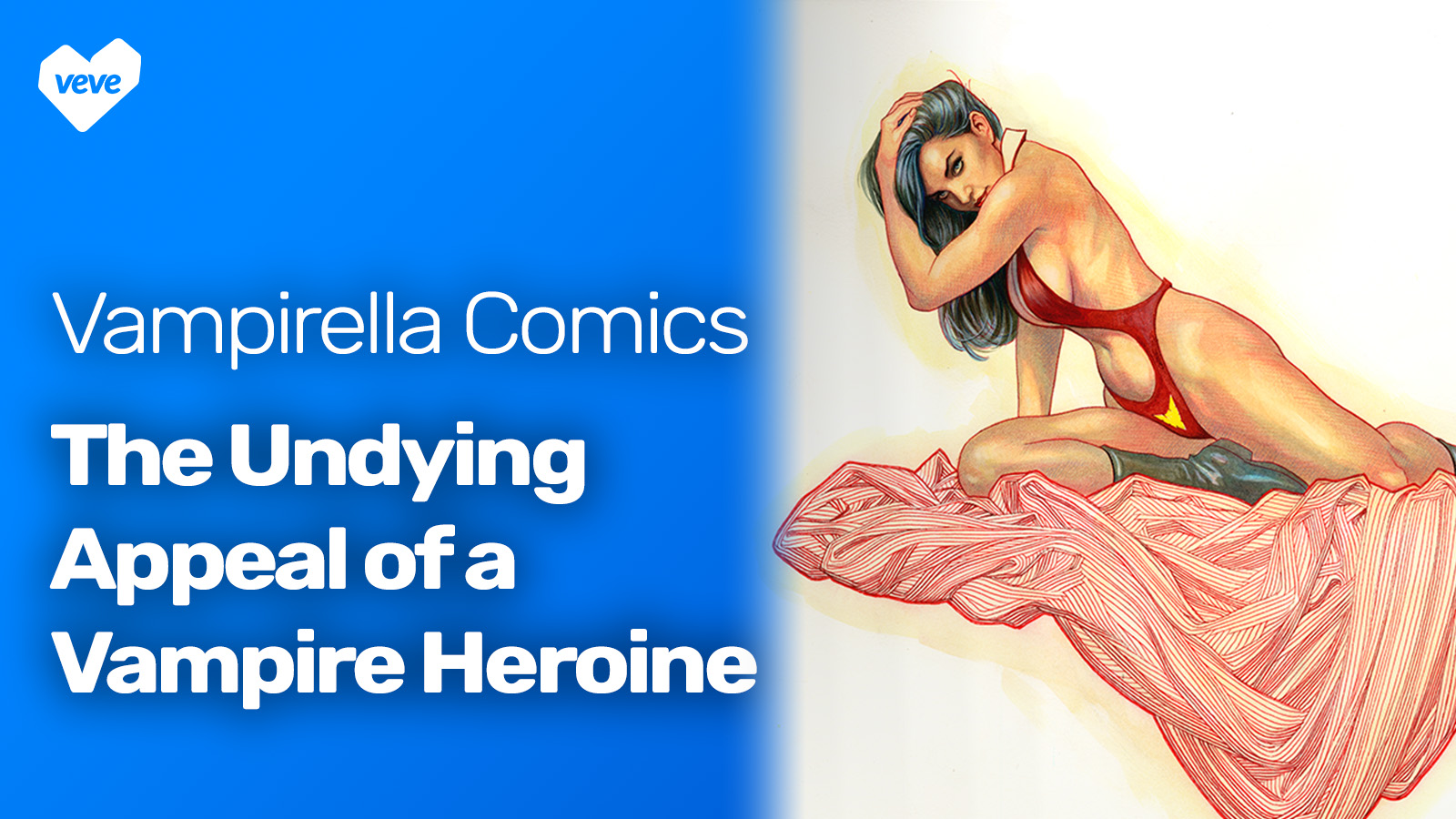
Who or what is Vampirella? Ask a comic fan of a certain age and they’ll point to the vampire heroine in the signature red costume, slaying monsters since the late 1960s. But Vampirella comics are more than a striking cover image. Across multiple publishers and eras, creators have shaped her into a resilient blend of horror and action, with a mythology that keeps evolving. From her offbeat origins to a cult film detour, Vampirella remains a unique fixture in comics.
.jpg)
Vampirella is the lead character of a long-running horror series that blends supernatural thrills with a dash of science fiction. She first appeared in 1969 through Warren Publishing, debuting in the black-and-white magazine Vampirella #1. The character is credited to Forrest J. Ackerman, with Trina Robbins designing the now-iconic red costume that helped define Vampirella comics from the start.
In her earliest incarnation, Vampirella was a host character rather than the star of the stories. She introduced horror anthology tales, quipping from the sidelines. That changed with Vampirella #9 in 1970. Under editor and writer Archie Goodwin, Vampirella was fleshed out into a full-fledged protagonist. Goodwin gave her an origin story and a mission, transforming the vampiress into a comic heroine.
Originally, Vampirella’s story begins on Drakulon, a far-off planet where rivers run with blood. It’s a pulpy premise, but it set the stage for Vampirella’s unique twist on vampire lore. On Drakulon, blood is a natural resource, and her people depend on it to survive. When those blood-oceans begin to dry up, Vampirella is driven off-world. After crossing paths with an Earth spaceship, she arrives on Earth and discovers the truth that changes everything. Human veins hold the same lifeline her species needs.
Once on Earth, Vampirella makes a moral choice. That pivot turns her into a rare kind of lead for the era: a vampire anti-heroine who uses her abilities, from strength and shapeshifting to hypnotic influence, to protect people from monsters and the worst of humanity. It’s this blend that defines Vampirella comics at their best. Horror with a heroic edge. A creature who hunts creatures, living somewhere between vampire myth, pulp adventure, and superhero-style justice.
Throughout the 1970s, Vampirella’s adventures threw her against everything from gothic staples like witches and Dracula-style vampires to stranger, sci-fi terrors. The tone ranged from tongue-in-cheek camp to straight horror. All the while, the character’s visual trademark was her attire: the famous red one-piece costume with a white collar, resembling bat wings or fangs. It was a bold, skin-baring design that quickly became a cosplay favorite and a point of brand identity. Even as newer eras shifted toward more story-driven horror, Vampirella’s striking look and unusual origin story helped her stand out on comic racks, attracting a devoted fan following.
One of the common questions casual fans ask is, “Is Vampirella a Marvel or DC character?” The answer is neither. Vampirella has always lived outside the Big Two, in her own corner of horror comics. In fact, that independent status is part of her charm and longevity.
Vampirella was born at Warren Publishing, the magazine-era home of horror staples like Creepy and Eerie. Warren published Vampirella in a magazine format from 1969 to 1983, producing 112 issues. When Warren went bankrupt in 1983, the rights moved to Harris Publications, a different publisher, which revived Vampirella comics in the late 1980s and carried the property through the 1990s and into the early 2000s, mixing new material with reprints of the classic run..
In 2010, Dynamite Entertainment acquired Vampirella and relaunched the title, making Dynamite the ongoing home for Vampirella comics ever since. There have been crossover curiosities over the years, but Vampirella is not part of Marvel or DC continuity. You are not going to find her as a regular in Spider-Man’s New York or Gotham City canon.
Despite not having the backing of Marvel/DC, Vampirella has proven to be remarkably enduring. As Dynamite’s CEO noted when he acquired the character, “Outside of Marvel and DC characters, very few comics characters that debuted in the ’60s still resonate with fans today,” and Vampirella is indeed one of those exceptions. Her survival across decades, and through multiple publishers, speaks to a character that has a strong identity and fan base of her own. It’s to her unique appeal that Vampirella comics remain in publication while many other 1960s characters have faded away.
For new readers or those curious to sample the Vampirella franchise, it helps to know where to start. Here are a few standout Vampirella storylines that are often recommended, showcasing the character’s range:
.jpg)
“Vampirella: Morning In America” (1991) – A four-issue miniseries written by Kurt Busiek, this story was part of Vampirella’s 1990s revival under Harris Comics. Morning In America reframed Vampirella in a contemporary setting, pitting her against a political conspiracy intertwined with supernatural horror. Busiek’s take gave Vampirella a serious, story-driven tone that proved the character could thrive beyond camp. It’s often praised for its writing and for updating Vampirella’s origin (this is where the “daughter of Lilith” angle was fully introduced).
.jpg)
“Vampirella Lives” (1996) – A three-issue Vampirella comic series by writer Warren Ellis, with art by Amanda Conner and Jimmy Palmiotti, Vampirella Lives is credited with revitalizing interest in Vampirella in the mid-90s. Ellis treated Vampirella more as a horror-action protagonist, balancing her sensual image with a gritty storyline about resurrection and revenge. It’s a fast read but a fan-favorite, often recommended as a jumping-on point to see Vampirella in a modern light (by one of comics’ acclaimed writers).
.jpg)
“Blood Lust” (1997) – A painted graphic novel in two parts, Blood Lust was written by James Robinson and lavishly illustrated by Joe Jusko. It’s considered a highlight of the Harris era, revisiting Vampirella’s origin and her arch-nemesis Nyx in a visually stunning way. If you enjoy deluxe artwork, Blood Lust is worth seeking out (its painted pages were so popular that Dynamite recently reprinted it for new audiences).
%20-%20Grant%20Morrison%20%26%20Mark%20Millar.jpg)
“Vampirella by Grant Morrison & Mark Millar” (1997) – Yes, even superstar writers Grant Morrison and Mark Millar have had a crack at Vampirella. The duo co-wrote an arc for Vampirella Monthly in the late ’90s, later collected as part of Vampirella’s “Masters Series”. Their take was tongue-in-cheek and subversive, as you might expect – a quirky piece of Vampirella comic history that shows how versatile the character can be in different hands.
.jpg)
The 2019 Vampirella series (Writer: Christopher Priest) – In recent years, Dynamite’s biggest splash with Vampirella came with her 50th anniversary relaunch. Veteran writer Christopher Priest (known for Black Panther and Justice League) took the helm in 2019. Priest’s run (often just called “Vampirella (2019)”) dug into Vampirella’s psychology and backstory in new ways, even as it delivered wild horror set-pieces. It’s a more introspective and modern-feeling series, and a great example of how Vampirella continues to evolve. New readers can start with issue #1 of the 2019 series and get a self-contained story that still honors the past.
Of course, for those who love classic horror, the Warren Publishing era stories (1969–1983) are worth exploring too – many of those short tales still hold up as eerie, vintage horror. Collections like Vampirella: The Essential Warren Years reprint the best of that era, including stories written by Archie Goodwin and drawn by artists like José González (whose depiction of Vampirella is considered definitive by many fans). Whether you start in 1969 or 2019, there’s a Vampirella comic out there to suit different tastes – from campy fun to serious gothic horror.
One note for collectors: Vampirella’s chronology has been rebooted a few times, so don’t worry too much about continuity when picking up these recommendations. Each of the above stories can be enjoyed on its own.
In the end, the story of Vampirella is the story of an unlikely comics survivor. What began as a horror-mag standout in 1969 has evolved into a cross-media cult icon. She’s a figure who straddles genres – superhero and horror, camp and serious – and in doing so, she’s kept herself relevant through generations of comic fans. That balance is exactly how Vampirella comics have stayed relevant across generations of readers and creators.
Whether you’re drawn by the horror, the artwork, or just the sheer curiosity of a heroine named Vampirella, this franchise has plenty to sink your teeth into. With new comics continuing to release from Dynamite Entertainment, Vampirella comics are very much an ongoing adventure. Over 50 years since her creation, Vampirella proves that some characters truly are undying. If you haven’t met her yet, now might be the perfect time to open a Vampirella comic and let this vampiric avenger show you why she’s still queen of her domain.
For comic collectors, Vampirella offers a rich vein of history to dig into, from classic magazines that echo the Hammer horror era to modern runs packed with bold storytelling and striking variant covers. For casual readers, she feels both nostalgically retro and surprisingly modern, depending on which era you choose to explore.
Ready to take that next step? Step into VeVe and explore Vampirella comics for sale, where iconic covers and standout issues come together in one place. Build your collection, discover something new, and let Vampirella claim her spot in your digital comic lineup.
Everything you read here is written by fans, for fans. This article was created by VeVe and is not officially affiliated with or approved by any licensor. All content referenced belongs to their respective rights holders.


Founded in 2018, VeVe was created for collectors by collectors to bring premium licensed digital collectibles to the mass market. With over 8 million NFTs sold, VeVe is the largest carbon neutral digital collectibles platform, and one of the top grossing Entertainment Apps in the Google Play and Apple stores. #CollectorsAtHeart

